The 7th Saga
The first of many Super Nintendo JRPGs. This one is punishing, infuriating, beautiful and original.
- Developer
- Produce!
- Publisher
- Enix
- Released
- 1993
- Region
- North America & Japan (As Elnard)
- Players
- 1 player
- Genre
- RPG
The Game

The 7th Saga is a punishing JRPG with a unique twist to its gameplay. I said in my first review that licensed platformers were the Super Nintendo's bread and butter, but I think you could say that licensed platformers are the bread, and JRPGs are the butter for the Super Nintendo library. The backbone of 90s Nintendo gaming. The Super Nintendo is where JRPGs really started to take big steps away from their 8-bit counterparts, and to this day brand new JRPGs are released in this graphical style. It really is timeless.
It was developed by Produce!, who also made Super Bomberman and Super Bomberman 2 on the SNES, Neo Bomberman in the arcade, Brain Lord (another very well-received SNES JRPG) and a Japanese-only title called Mystic Ark, which was a quasi-sequel to The 7th Saga. The game was published by Enix of future Square Enix fame. The first game on the list to be published by them, but certainly not the last, as they had some of the biggest JRPGs ever released before the Square merger.
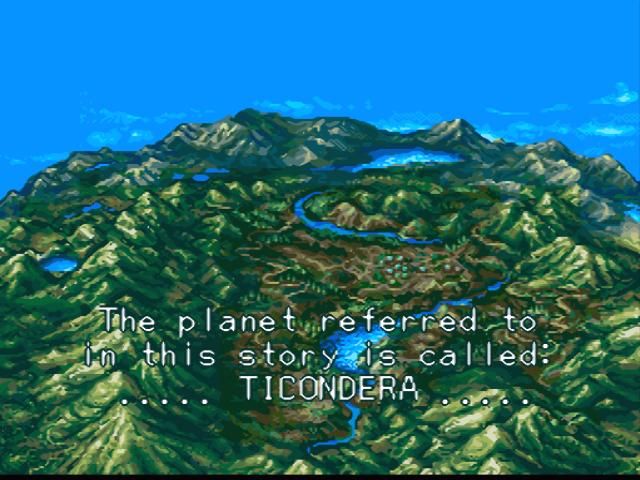
Gameplay
Mechanically this plays like most turn based JRPGs. You walk around an overworld, visiting towns and dungeons, talking to people, spending money in the various shops, until you hit a random encounter that puts you into the battle scene, at which point you fight until someone dies. Hopefully not you… But quite likely you, this game does not fuck around!
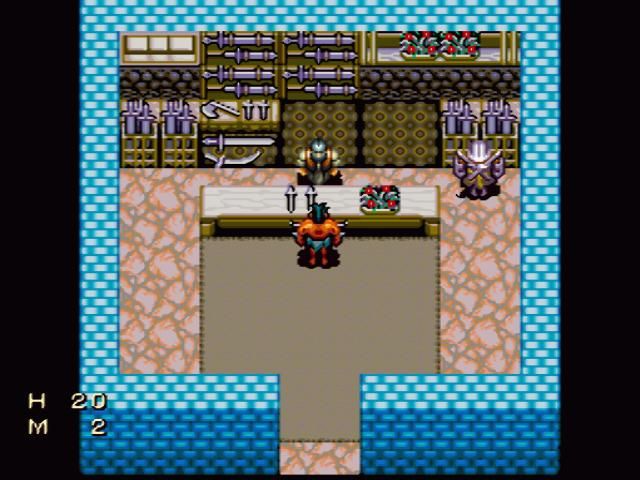
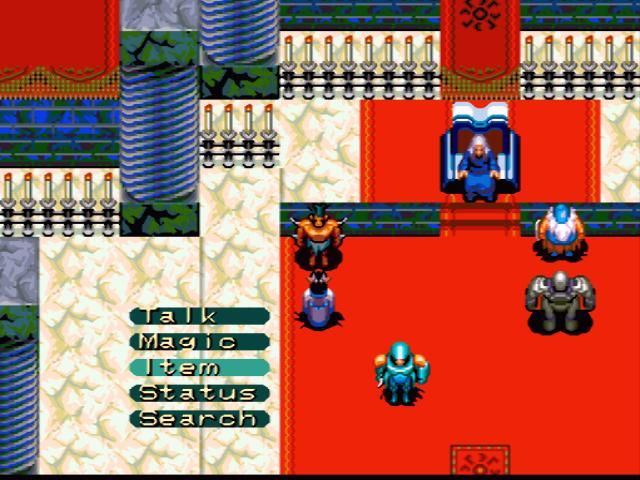
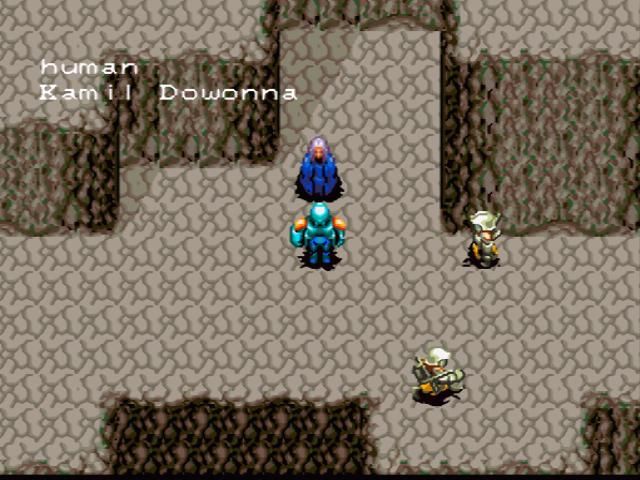
The game brings 7 apprentices together to save the world - standard story for this sort of game. These 7 apprentices must find 7 runes to seal away the evil trying to take over the world, and these characters are where the first innovation attempt is brought into play. You choose one of these characters in a similar way to how you'd choose a character type in a Final Fantasy, but the interesting part is once you've chosen your character, the remaining characters are dropped into the world and they are trying to complete the same quest as you. You'll come across them in towns: some will offer to join you, some just won't care about you, some will even betray you and try and kill you. You can even lose runes you've collected to these characters if you fall to them in battle. It really does make this a unique gameplay experience.
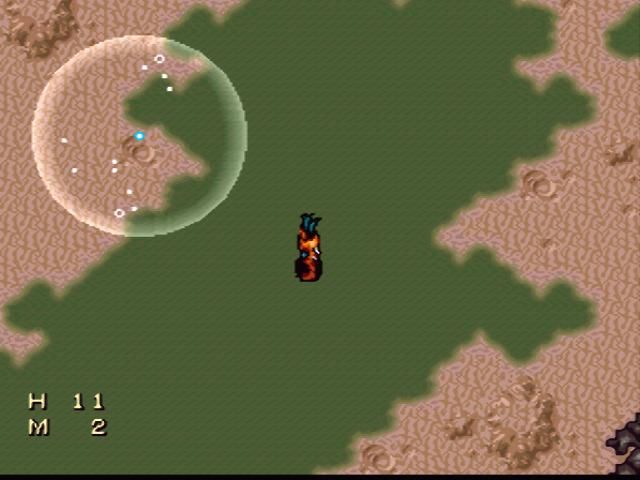
The other attempt at innovation (for the time) is a crystal ball that gives you a radar as you walk the overworld. On this radar you can see towns, towns flash red if there is a rune inside, and you can see enemies. The random encounters aren't so random, and the idea is you can avoid them if you would prefer to. There are 2 problems with this. One is the enemies move so erratically there's just no feasible way to avoid the encounter. The second problem is the game is really fucking hard, so you have to level up, you have to grind, so you have to fight the enemies if you want any chance of completing the game, but adding to that difficulty is the high encounter rate. You have really hard battles back to back to back, and when you just want to get from one town to the next quickly, it does get frustrating.
Supposedly the difficulty of the game was increased for the Western audience, and they halved the rate of experience earned - and it certainly feels like that! Although during research I came across an interview with Robert Jerauld, who worked on localisation, and he had something slightly different to say:
I was closely involved in the development of the 7th Saga. And no, while I believe it's probably not as exciting to hear, we didn't increase the difficulty level from the Japanese version. It's possible the game had tuning changes from the Japan side to the US version but it wasn't a mandate to make the game harder. It's likely that we determined the game in Japan wasn't challenging enough based on feedback, and thus, tuning adjustments were made. We changed some of the puzzles, in terms of the questions you were asked in order to solve the puzzle but the challenge remained the same.
Keep in mind: at the time, you had a wide range of age groups playing SNES games. Depending on your age level the game was either pretty straightforward or challenging. If I think back on some of the puzzle questions, and imagine an 8 year old trying to figure out some of the riddles, yep, would have felt impossibly hard. We just posed riddles meant to get people thinking but impossibly hard? Not even close. You want to talk about hard, try Ninja Gaiden 2… That was the bar of difficulty back then and was responsible for more broken television sets, consoles and controllers than any other game to date. (Only to be topped by the first release of Street Fighter.)
The full interview is a good read and can be found here.
The battle mechanics themselves are difficult too. Usually in a JRPG, battles are designed so offensive strategies are enough to see you through, but in this a regular attack does barely any damage; an attack after defending will do a critical hit. This drags the battles on forever and gives the enemy a free hit every other turn, and the enemies' dodge rate is through the roof. In the majority of battles it would be 50% of the attacks that got dodged.
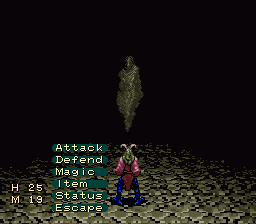
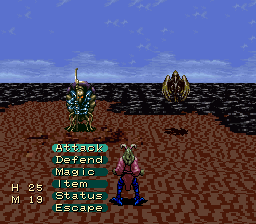
So a standard attempt at battle would be:
Defend, get hit by the enemy, attack for the critical hit, attack is dodged, enemy attacks you, defend again because you lost your crit chance, get attacked again, and then attempt your critical hit and pray it doesn't get dodged again or you have to repeat the cycle once more. Very frustrating!
There are some really nice details about the game though. One of my favourite things was some of the context-sensitive dialogues with NPCs. Go into town while poisoned, and someone you just spoke to would have different dialogue recognising you're poisoned and telling you where to get an antidote. Meet up with another of the 7 while your partner is knocked out, and they'll say how you've failed your partner. Little touches like that just make the game world feel much more alive. That, combined with some of the interactions you can have with the 7, really makes the game stand out above its flaws. At one point one of the 7 challenged me to a fight. This was an optional fight that, as far as I'm aware, doesn't happen in every playthrough, but when I won that was it - he was dead and gone from the story forever. The game really does make some ballsy decisions and I have to give it credit for that.
Graphics
The graphics in the game are the big selling point. The sprites are beautiful and made the insanely punishing battles bearable. I was genuinely excited to get to a new area to see what different creatures there were to fight. The overworld and towns look very typical for a JRPG of the era, but still nice solid artwork that really was the standout feature of the game. Well, that and…

Sound and music
The music in this game is fantastic, a mixture of upbeat, techno-esque battle music, tension-building dungeon music, and hope-filling overworld music. The sound effects are what you'd expect but the music really is the highlight. Each track builds on one emotion or another, and they're not just ten-second loops - the soundtrack has 38 tracks and you can listen to it here.
The People
Looking at the people behind this game, there aren't too many surprises - veterans in the JRPG world in some places - but what surprised me most was that the game's Music Composer Norihiko Yamanuki has 2 credits only: this, and a game from 1990 called Mado King Granzort for the SuperGrafx.
The Graphics Director was Jun Kusaka, who went on to have an extensive career with work on Final Fantasy X, XII, XIII and XIV, and Kingdom Hearts II and III among others.
Robert Jerauld, who I mentioned earlier being part of the English-speaking localisation, is now an executive producer at Microsoft Games and has worked on Alan Wake, Gears of War, Microsoft Flight Simulator and Gears of War Reloaded most recently, so he's done alright for himself!
Box art
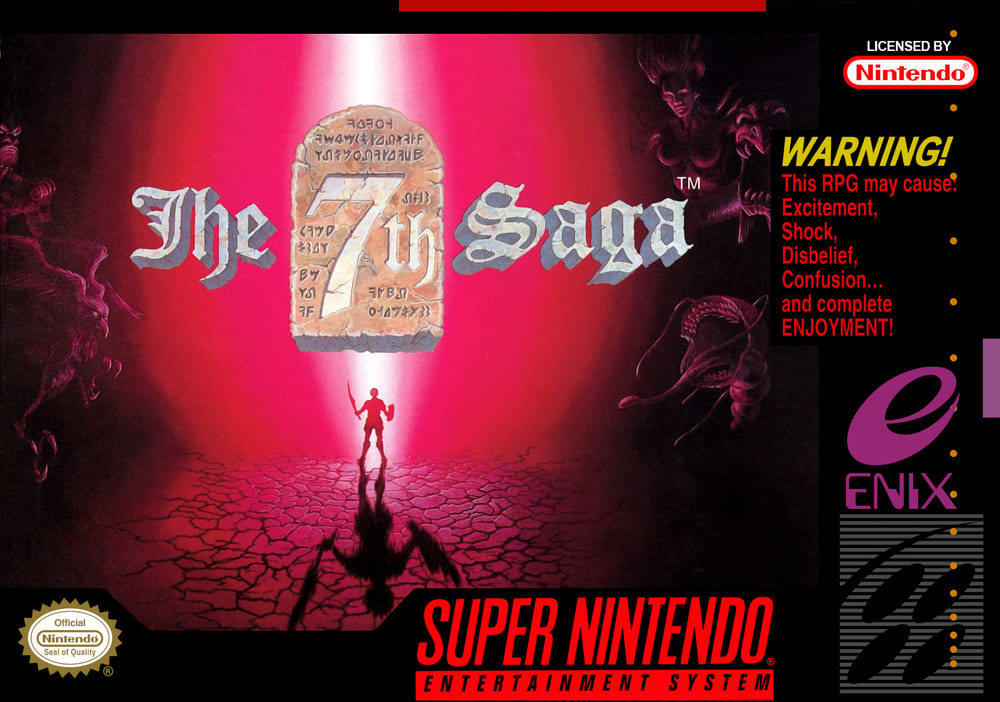
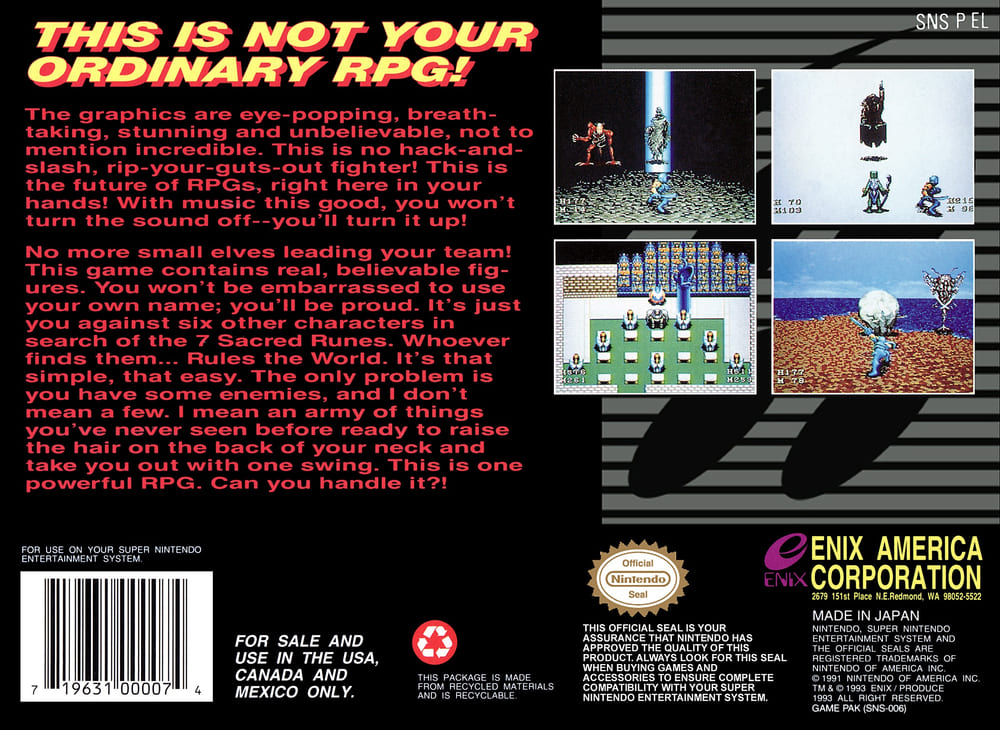
North American release, 1993.
Okay, let's look at the box art. Firstly, the front cover is certainly appealing and would've attracted my attention back in the day if it had been released here in the UK. The front gives a bold warning that is certainly fairly accurate, although "Complete ENJOYMENT" might be a touch too far!
Looking at the back brings a few questions. Firstly, the choice of screenshots doesn't do the best job of selling the graphics: bottom left looks like it could be a NES game, and the top 2, while having interesting sprites, have pretty poor backgrounds!
Let's break down the text on the back:
-
The graphics are eye-popping, breath-taking, stunning and unbelievable - Yeah, I'll give them that one!
-
This is no hack-and-slash, rip-your-guts-out fighter! - Again, accurate, but a bold move to start by advertising what your game isn't!
-
This is the future of RPGs, right here in your hands! - Debatable.
-
With music this good, you won't turn the sound off - you'll turn it up! - Again, true, but who was going around playing their SNES with the sound off?
-
No more small elves leading your team! This game contains real, believable figures. - Okay, this one I really have an issue with…
Firstly, I'm guessing it's a dig at Final Fantasy, maybe Dragon Quest too, but point 1: since when is having an Elf leading the team a bad thing? Also point 2: I spent half the game teaming with a character called Esuna. Esuna is an Elf… So, what are we even trying to say here?
Also also, real believable figures? Let me list the characters in the game really quick:
- Valsu - The Human
- Esuna - The Elf
- Lejes - The Demon
- Kamil - Another Human
- Olvan - The Dwarf
- Lux - The Tetujin (a robot)
- Wilme - The Alien
Ah yes, those classic "believable figures".
Then some typical game-selling blurb, finishing with:
- This is one powerful RPG. Can you handle it?! - I mean, honestly? Without save states? No… and to expect little 7-year-old me to be able to is absurd!
Overall I give this box a rating of - Mostly accurate. But trying too hard to be the "cool new RPG", punching down on franchises that left it in the dust.
The Press
Magazine reviews for this were a bit easier to find than on my last attempt, and we even got a mention of it in GamesMaster magazine over here in the UK, despite it not releasing here. Here's what I found:
Game Players:
Another sprawling RPG from Enix, this one distinguishes itself because the game follows slightly different paths depending on which of the seven characters you choose — adding unheard of replay value!
88 out of 100
Electronic Gaming Monthly (EGM):
The best thing about this RPG is you can play it repeatedly and never get the same game twice! The non-linear game play and excellent Mode 7 sequences make this the RPG to get. Soul Blazer fans should take a look.
38 out of 50
GamePro:
If you're a connoisseur of RPGs and don't mind incessant combat, you'll want to have this game in your collection. However, Enix may want to think twice before creating an Eighth Saga.
3.5 out of 5
GamesMaster:
This isn't a console game: it's a slow night of Dungeons and Dragons, with paper and dice. As PC role-playing games seem to become more imaginative and dynamic every month, why is the SNES being lumbered with this relic?
46 out of 100
The verdict
6/10
Above average. I respect it for what it tried to do different, but there was just too much going against it to give it a higher score.
7th Saga intro scene. All credit to Sieffre Plays on Youtube.