A.S.P Air Strike Patrol
4 games, and 4 different genres. People are going to start thinking I'm lying about the SNES being full of platformers, and RPGs! Just you wait though...
- Developer
- Opus Corp.
- Publisher
- SETA
- Released
- 1994
- Region
- North America & Europe (As Desert Fighter)
- Genre
- Action, Shoot 'em up
The Game


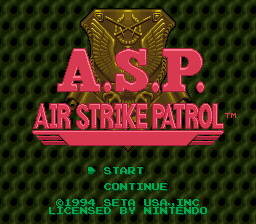
A.S.P - Air Strike Patrol is a top down action flight simulator which does try a few things to separate it from the shoot-em-ups of the era. Also known as Desert Fighter in European regions so it should have been a lot later down the line seeing as I'm in the UK, but I used an American-centric list to get my list of games before I realised this, so now I have to commit to the American names for games in this review series because I'm nothing if not consistent.
It was developed by Opus Studios, who were a Japanese developer established in 1990, and only just closed down a couple of years ago in 2024 - they had a long career but no real standout titles. One of the games they developed was Half Minute Hero, which is a fantastic game that I urge people to try out. It was published by SETA, who were also involved in the publishing of a lot of games with no real standouts. The USA branch SETA USA was also credited in the publishing of the game, and they did publish quite a few SNES games, but again nothing really outstanding.
Gameplay
Set in a fictional version of the Gulf War against a country called Zaraq - a little bit on the nose, but it's fine! It's an isometric shooter, and you pilot one of two different aircraft: an A-10 or an F-15, each having slightly different play styles. As you can imagine the A-10 is slower and more focused on bombing runs, while the F-15 is faster and well suited for air to air combat.
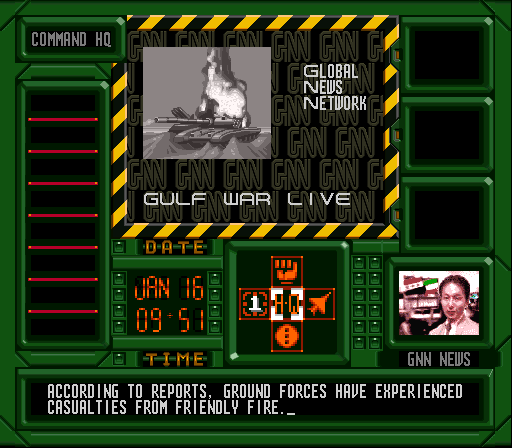
Jumping in I expected a typical top down shoot-em-up - you get dropped in to an area, blow it all to pieces, come home victorious. So I'm flying my F-15 and I see some tanks, I fire off some air to ground missiles, wipe them out, then I see some buildings and I wonder how good the damage modelling is. Can all the buildings be destroyed? The answer is yes! I didn't really know what I was doing, I'd jumped in without reading anything, so I flew off the side of the map which ended the mission and sent me back to HQ. When this happens you get a news broadcast screen pop up to tell you how you did. This particular time they seemed quite keen on discussing huge amounts of civilian casualties and friendly fire…
So it turns out the battlefield has your own troops on it, it has civilian towns, and you are tasked with destroying very specific things in a certain amount of time. Who knew?
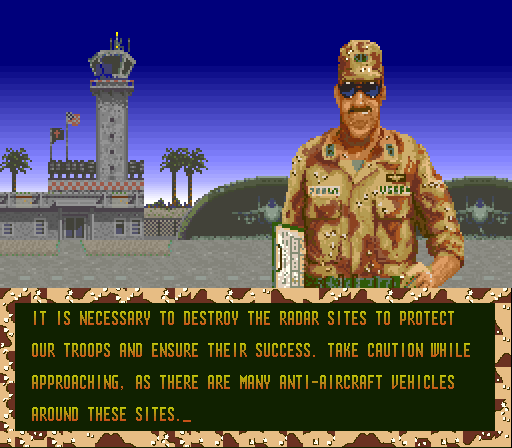
What I'd missed was the pre-mission intel screen that tells you all about what you need to do, shows you the sprites of your allies, your enemies, your targets and so on. Armed with this knowledge I went back in and started to have a great time.
The feel of the planes is really nice - you have speed controls and an actual turning circle in the air, so when you're in a dogfight with an enemy fighter you have to think about slowing down and speeding up to try and get behind them. When you're on a bombing run in the A-10 you need to consider the time remaining on your mission, it being a much slower and more methodical gameplay style. I did find most of the missions were geared toward bombing runs, so the A-10 was used mostly, although the F-15 was really good for a quick recon. You get a certain amount of in-game hours to complete your mission, and you can do multiple flyovers in that time - so I'd go out in the F-15, take down as many enemy MiGs as possible while searching the map for the objectives, then once I had the lay of the land I'd come back out in the A-10 and start the bombing runs.
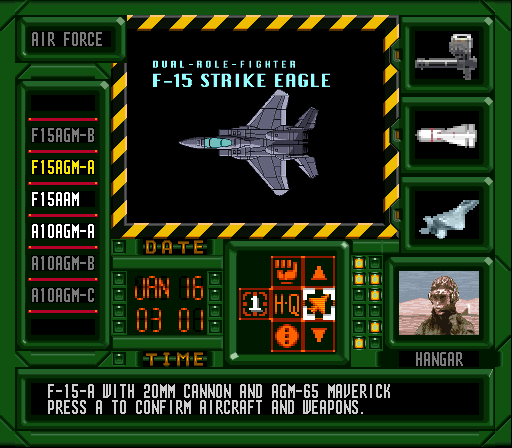
Not only do you have to consider the time, but your fuel and ammo are limited in each run, so you really have to make every shot count if you want to complete the mission on schedule. I really liked the way this all felt - it almost gave the game a sense of realism and a bit of planning. Failed missions don't end the game, but they can make later missions harder, make people start to dislike you, and can even affect the ending.
Everything in the game just feels satisfying, especially the bombing runs - bombing a huge refinery and seeing all the destruction in your wake never got old. So while the gameplay loop is repetitive, it's so much fun it didn't really bother me. The targets were visually distinct enough, and the story was intriguing enough to keep you pushing on.
Graphics
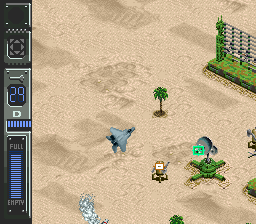
I love the graphics in this game. The planes look great with a 3D-esque look to them as you're turning in the sky above your targets, loads of nice big sprites with good looking animations, and some great destruction sprites after the fact too - every building, every unit, they all have destroyed sprites that stay on the battlefield when you're finished.
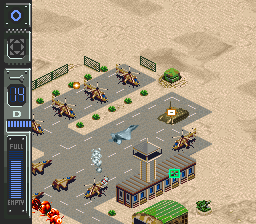
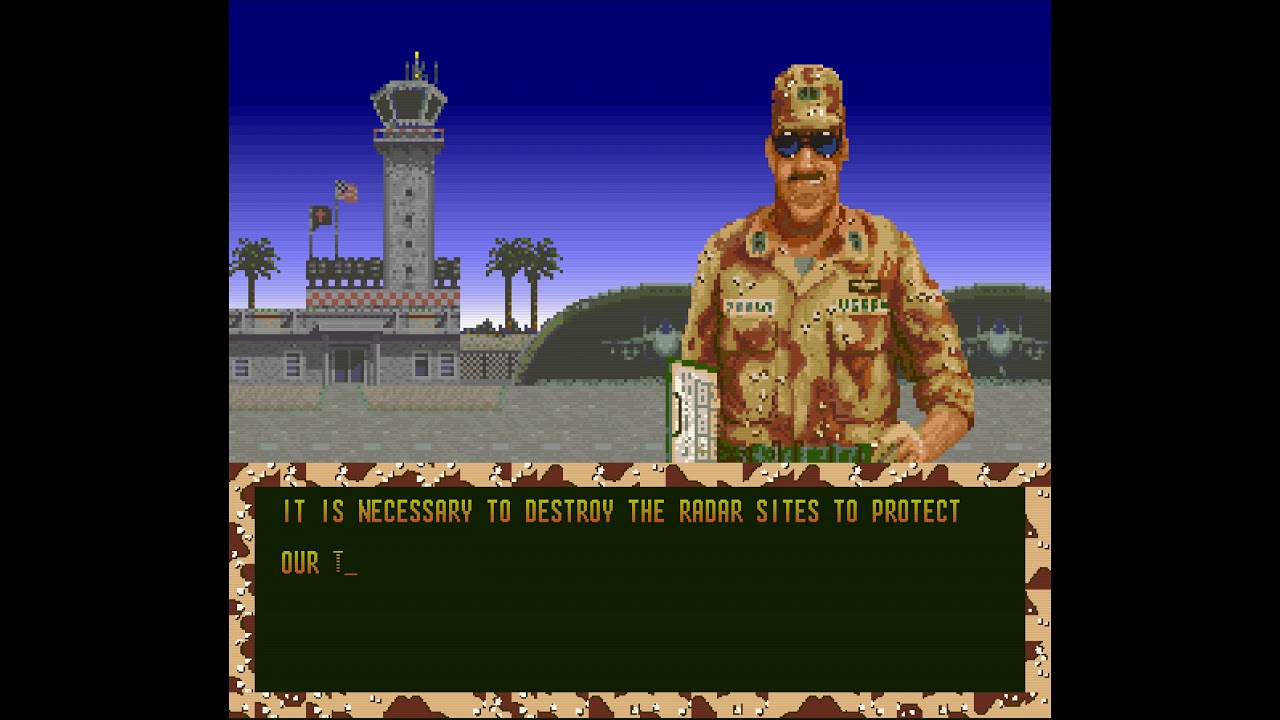
There was some nice artwork between missions too: the CNN-style news report, the pixel art drawings in the mission briefing, there's even a small but great looking digitised person at the bottom of the screen during your briefing that does exactly what it needs to.
The aesthetic of the mission briefing in general is really well done - very clear layout, just all put together nicely, and a pleasant surprise.
Sound and Music
Both great. The sound is exactly what you want from a game like this: explosions, bullets whizzing past, rockets launching with a whoosh, tension-filled lock-on warning beeps - it does everything you'd want it to do. Coupled with the music it makes for a really good package, and by far the best all-round package I've heard in the series so far.
The music is a good mix of high-octane high-tempo tracks, slower more relaxed pieces, and then some really funky jazzy stuff to top it all off. Well worth a listen and can be found here.
The People
Going into the people behind this game we may as well start with the music, seeing as that's where I just left off. Like the developer and publisher, Jun Enoki worked on a lot of games but never really anything too standout. The last game they worked on was in 2018 - Onimusha Warlords. One of the first games they worked on was a Japanese-exclusive Where's Wally (Waldo) game called Wally wo Sagase! Ehon no Kuni no Daibōken, which may seem an odd thing to bring up, but it will be relevant.
The person responsible for the 3D models was credited as K. Suzuki, and they worked on this and also did 3D models for Digimon World 2 on the PS1, and that's it - those are the only games they worked on. Yet they had Special Thanks credits on Shin Megami Tensei and Chrono Trigger, so how that happened is beyond me!
Seven people worked on the graphics for this game. Four of them were never credited on another game after this. One was credited on two games - this one and Wally wo Sagase! One was credited on three games, including Wally wo Sagase! Two people were credited for game design: one only ever worked on this game, the other worked on this and one other. Guess which one? Yep, Wally wo Sagase! Ehon no Kuni no Daibōken. Nine people on this game were also credited on that one, and the majority of them never worked in gaming again - a surprise, given how well put together this game is.
Box art
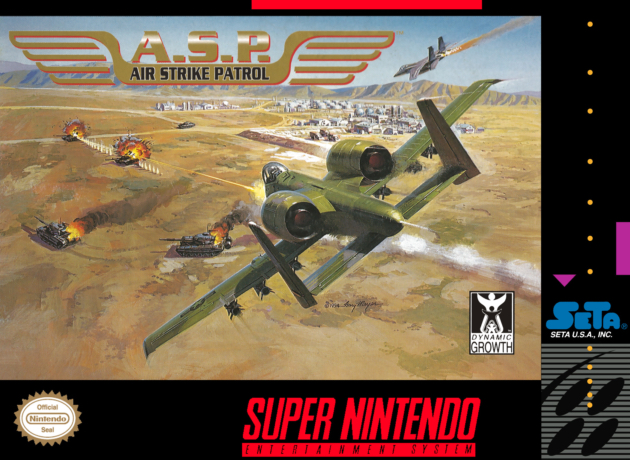
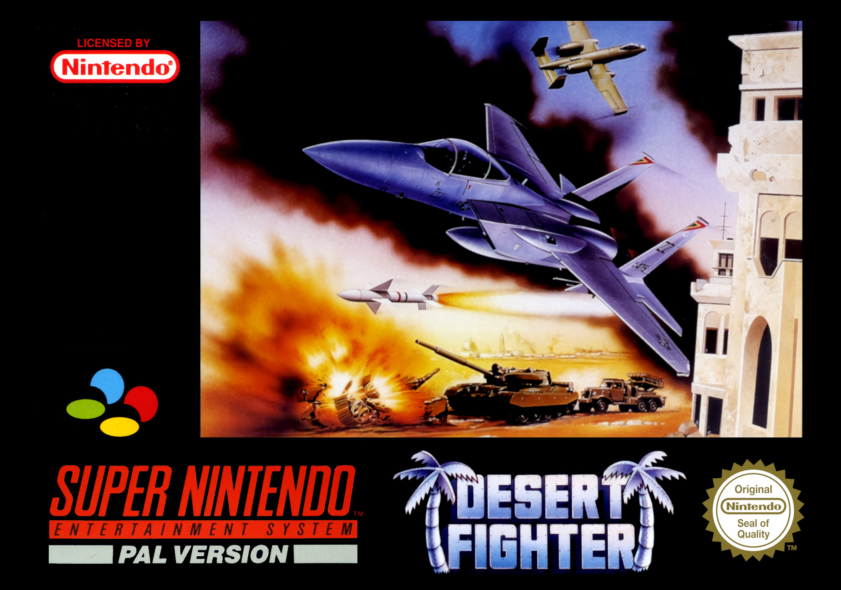
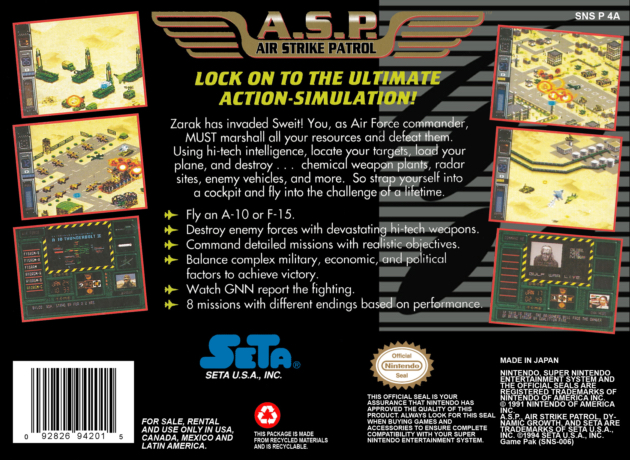
North American release as A.S.P Air Strike Patrol, 1994. European release as Desert Fighter.
A treat this time - two completely different front covers to look at. Both sell the game for what it is, and I think I'd have been drawn to either of them had I seen them in a game store growing up. I give the edge to the US art though: it's got a hand-drawn style that I really like, really detailed, and it puts the A-10 front and centre - my plane of choice for the game. The EU art is really nice too, but I prefer the lighter look of the US one.
One thing I find interesting about the box is there's no mention of Opus anywhere - only SETA. The only other name on the front is Dynamic Growth, which after a bit of research turns out to be a trademark of SETA, used as a slogan across their games. So nothing about Opus at all, and they made the damn game!
Having a look at the back, I like it a lot - six crisp, clear screenshots surrounding the game's blurb. The description is accurate, but let's have a look at those bullet points. I love to dispute a box art bullet point:
- Fly an A-10 or an F-15 - Okay… nothing to dispute there.
- Destroy enemy forces with devastating hi-tech weapons - Got to agree with that too. 2 for 2.
- Command detailed missions with realistic objectives - Again, true. Dammit game, why won't you let me rip into you!
- Balance complex military, economic, and political factors to achieve victory - All tied into the multiple endings, so yes - accurate!
- Watch GNN report the fighting - Those news reports I mentioned. That's GNN.
- 8 Missions with different endings based on performance - True. A clean sweep for A.S.P - the first we've seen.
The one thing I will say is 8 missions doesn't seem like the biggest selling point, but the multiple endings do add to that a bit.
Overall I give this box a rating of - Accurate. Everything it said was completely true, and it sold the game pretty well.
The Press
Computer & Video Games (CVG):
I'm not a fan of strategic war games at all, in fact I generally loathe them. That is until I came across Desert Fighter. There is so much to do in this game and it isn't all about bombing everything in sight, which is what I usually do! The graphics may look very realistic and the accompanying sound is just as good. You can really hear the engines of the planes and the bombs blasting on the ground and it doesn't glorify war at all, which is another bonus. It's challenging and gripping and I'd say worth every penny.
94/100
GamePro:
For serious airware buffs who have flown EA's Strike games and F-15 Strike Eagle, ASP is your next objective.
4/5
Electronic Gaming Monthly (EGM):
Veteran players of these kinds of flying games will immediately take to it, but for others it will take practice to get the game control down (being a jet, you may have to make several passes over a target in order to destroy it). Still, the cinemas are well done (the GNN news is a nice touch), and there are plenty of weapons to use.
28/50
The verdict
8/10
By far the most fun I've had in this series, lovely graphics, a great soundtrack, engaging sound effects, and really fun gameplay to boot. The only thing holding it back is longevity, and a repetitive gameplay loop. Multiple endings are maybe not enough to bring people back.
10 minutes of Air Strike Patrol. All credit to 10 min. of SNES on Youtube.