ActRaiser
Is it another action platformer? Yes, and no...Part platform hack & slash, part city builder God game. Innovative, and fantastic.
- Developer
- Quintet
- Publisher
- Enix
- Released
- 1990
- Region
- Japan, North America and Europe
- Genre
- Platformer, City Builder
The Game
ActRaiser is one of the earliest releases for the SNES, coming out the same year the console launched in Japan, and America 1990 and 1991 respectively, and came out in 1993 in Europe, a year after the console's initial release. It was a hopeful sign of things to come for the console with something new and innovative right off the bat.
Developed by Quintet who had a really strong start developing for the SNES with titles like this, ActRaiser 2, Illusion of Gaia, Terranigma, Robotrek, but after that they slowed down, and haven't had any credits since 2006.
Published by Enix who I mentioned in my 7th Saga review, who were responsible for some of the best games on the system and prior. Dragon Quest/Dragon Warrior, Soul Blazer, Star Ocean. Before eventually merging with Square in 2003 to create the powerhouse company we know today Square Enix.
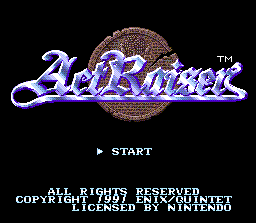
Gameplay
As I've mentioned, this game is a hybrid of two genres, and while I am about to glaze the absolute shit out of it, I will say with all honesty, while it does both genres competently, and combining them together was a genius idea, I have played a lot of hack & slash platformers that are better than the hack & slash platforming of this game, and I have played a lot of city builder/God games better than the city builder/God game of this game. But I've not played anything (so far) that has combined the two and made it a really fun experience.
You play as God, simple as that. Although you never actually directly control God, you control an Angel in the city builder, and you possess a statue in the platformer, but it's made very clear that you are a deity, and everyone is looking to you for support. The world you look over is in a bad way, monsters have broken out of portals all over the world map, and it's your job to clean the place up.
You start by flying over a world map, fairly reminiscent of an RPG world map and find the first area that needs help, in that moment it's just an empty space of land full of monsters and the first port of call is to get your hands dirty and go down and clear some of it out and this opens with the first platforming section. You take possession of a statue turned knight, and go through a standard platforming level slashing your way through various monsters until you make it to the end.
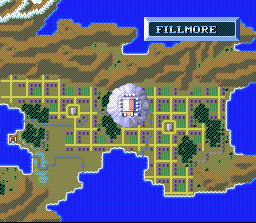
Making it to the end of the level gives the area a small amount of respite, allowing humanity to return, and in comes the city building aspect. You take control of your little angel buddy who flies above the map and your objective is two fold, firstly your angel can fire arrows and there's a slight top-down shooter aspect as you protect your villagers from monsters emerging from monster nests, your second objective is to direct your villagers, as you send them in a certain direction they build and expand the village, and once roads have been built to the monster nests they'll do a ritual to close the nest and allow the village to grow without having buildings and farms burned down or villagers kidnapped.
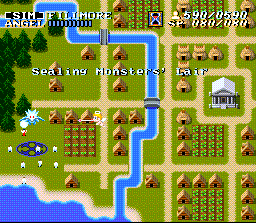
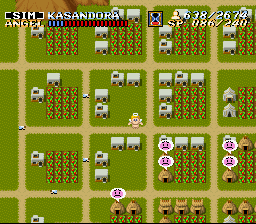
Eventually your villagers will make requests of you at a temple, firstly they need bridges, but as you progress you'll have villagers in a northern area of the map telling you they need furs for warmth, some need medicine for a plague, and these are things other villages will find as they progress, and will be left to you as offerings for you to provide to the people in need. You also have God powers, lightning, rain, earthquake etc and these will all directly affect the world. A village may need to progress north to close a monster nest but a large forest will be in the way, your lightning will make short work of it and burn it down to let them push forward.
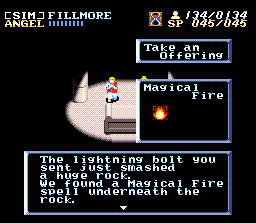
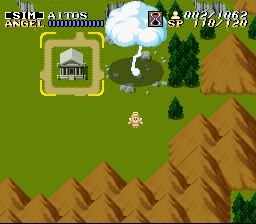
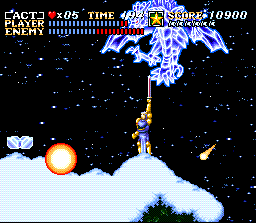
Once your villagers have sealed the nests they will come to you with another request, in one example a village child has gone missing and they ask you to find them, this is your cue to follow their instructions and get to that area's boss level. In that level you're back to the platforming, and the level ends with a boss fight. This is essentially the gameplay loop, but the city building does give you the chance to up your city population by performing certain tasks, unlocking better buildings so after a quick lightning "accident" and some burned down houses, your devoted followers will rebuild with their better quality housing, bringing in more people, and in turn more offerings that you can take in with you to the action levels. These are spells that can be used for different things in the level, the best of which is a screen clearing star attack that is a huge help when fighting the bosses.
Graphics
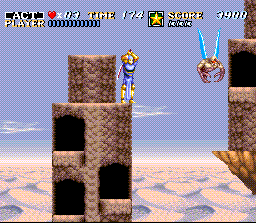
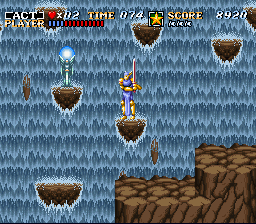
For such an early SNES release I think the graphics are really nice, ultimately they are basic by later release standards, but considering the NES was the baseline just a year before it offers some really nicely designed sprites in the action levels, varied backgrounds, and some really interesting designs for bosses.
The world map is simple, but the buildings are distinctly different, farms have little crops, buildings look different as they get upgraded, and the different areas look varied enough to keep the game from getting stale visually.
Sound and Music
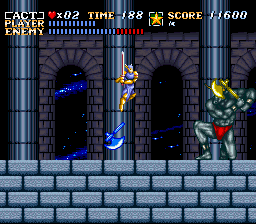
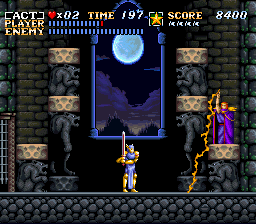
Unsurprisingly for an Enix game, the music is fantastic, a whole host of full length tracks, over 30 minutes of great music, and the sound is exactly what you'd expect, swords clashing, arrows firing, if you've played a hack & slash game before you know what to expect here and it does deliver. The music is the stand out over the sound though. Listen to the soundtrack here.
The People
Wow, so this could be why the music is the standout, Yuzo Koshiro did the music for this game, and here's a short list of what he went on to do: Streets of Rage 1, 2 & 3, Sonic the Hedgehog, Shenmue II, Castlevania: Portrait of Ruin, Super Smash Bros. for Wii U and 3DS, Super Smash Bros. Ultimate, and is also credited on the 2026 game Mina the Hollower. That is just a very small snapshot of this man's career, still going strong today.
That was really the only standout person in the credits of ActRaiser, most the other people that worked on this game worked on the other Enix SNES games in the 90s and then fizzled out in the early 00s.
Box art
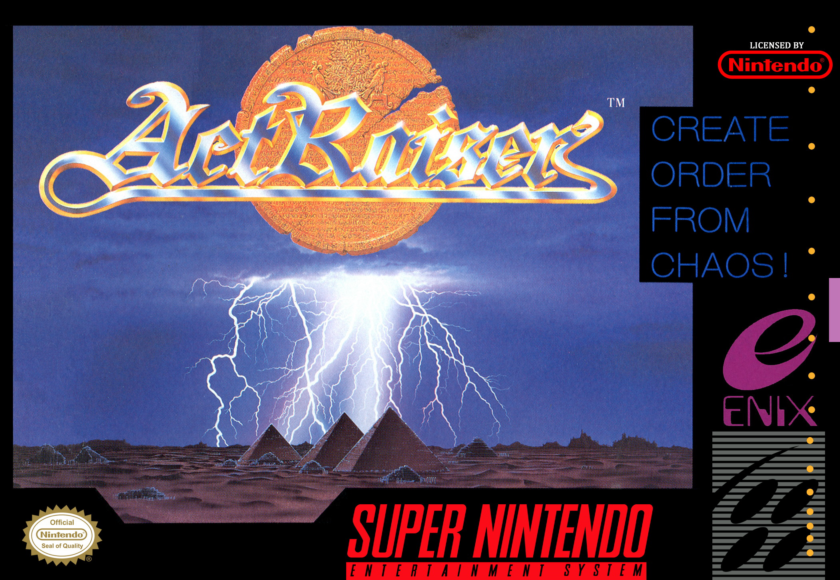
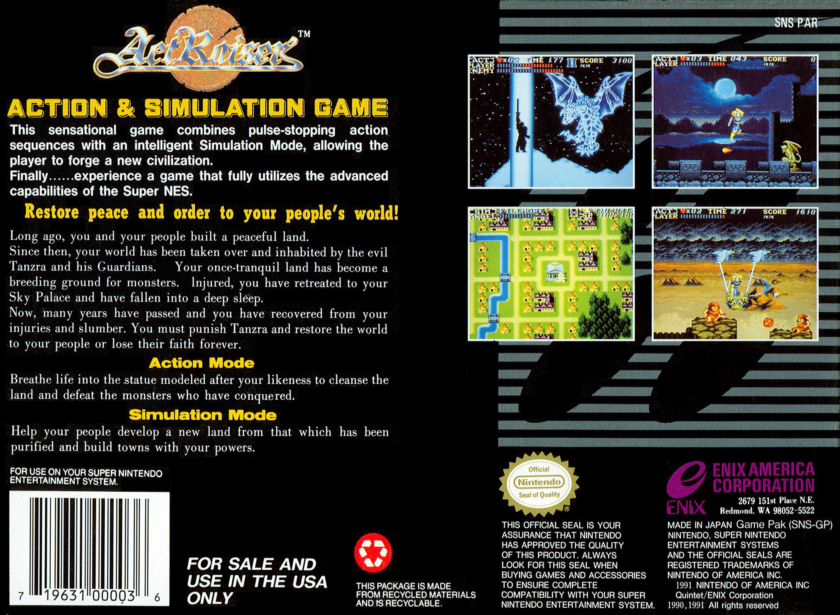
Looking at the front and it is a pretty cool image, lightning flashing over some pyramids, it's a nice image, but if I'm honest it might not have been enough to sell me the game if I saw it on a shelf in the 90s. I appreciate it a lot now, but I don't know how much 7 year old me would.
The back is laid out nicely, 4 nicely placed screenshots, well picked screenshots, and a short and sweet description of the game, sadly no bullet points, so I'll have to break it down.
- This sensational game combines pulse-stopping action sequences with an intelligent Simulation Mode, allowing the player to forge a new civilization. Finally......experience a game that fully utilizes the advanced capabilities of the Super NES. - This seems true to me, you could maybe argue "sensational", "pulse-stopping" and "intelligent" but remembering this came out in 1990/1991 at the earliest I think they're fair descriptions.
- Breathe life into the statue modelled after your likeness to cleanse the land and defeat the monsters who have conquered. - This is just explaining one of the aspects of the game, but it is accurate.
- Help your people develop a new land from that which has been purified and build towns with your powers. - Again, just describing the game really, but it is accurate so I have to give it that.
Overall I give this box a rating of - Accurate. It's basic, not much to it, but it is accurate.
The Press
Computer & Video Games:
The old saying goes 'gobsmacking audiovisuals do not a good game make', but Actraiser mixes absolutely stunning graphics and sound with a game so addictive, you'll want to play it again and again. A special mention must go to the stunning movie-score-like incidental tracks which really do get the old adrenalin pumping! As Rich has said, the similarities of this to Populous and Sim City are somewhat obvious, but that's no bad thing by any means - the addition of some absolutely awesome arcade sequences only go to enhance the game further. Be warned, however - this sucker is tough, and will take a heck of a lot of practice to complete, but even so, Actraiser is a brilliant title that Super Famicom owners will go absolutely nuts over.
95/100
Super Pro:
A fantastic arcade adventure which is mostly an arcade game along the lines of Castlevania IV, but also has a Populous-style adventure section. It's big, it's beautiful and it's thoroughly recommended!
91/100
Mean Machines:
At first glance, this looked like a Populous rip-off with its "control your minions" idea. Once I studied the game in more depth, its great playability came apparent. The arcade sections are fantastic, and feature the best music ever heard on a console or computer and offer a challenge that's tough without being dispiriting. The graphics are also outstanding, especially in the final showdown. The strategic element works well, although it may put off some people - they'd be silly to miss a game of this quality. If you've a Super Famicom, this MUST be your next purchase!
91/100
Electronic Gaming Monthly:
This game is the perfect melding of Populous and Castlevania, with strategy segments that lead into incredibly detailed action sequences. The building sections are straight-forward enough and while the battle scenes lack power-ups, the detail in animation and sound is amazing.
36/40
The verdict
9/10
Fantastic game, so much better than the sum of its parts. The combination of action and strategy was such a new thing at the time and it worked so well. It would be such a shame if they released a sequel and stripped the most interesting part away from the game...

Original Japanese trailer for Actraiser. Sadly only in 240p

10 Minutes of Actraiser. All credit to 10 min. of SNES on Youtube